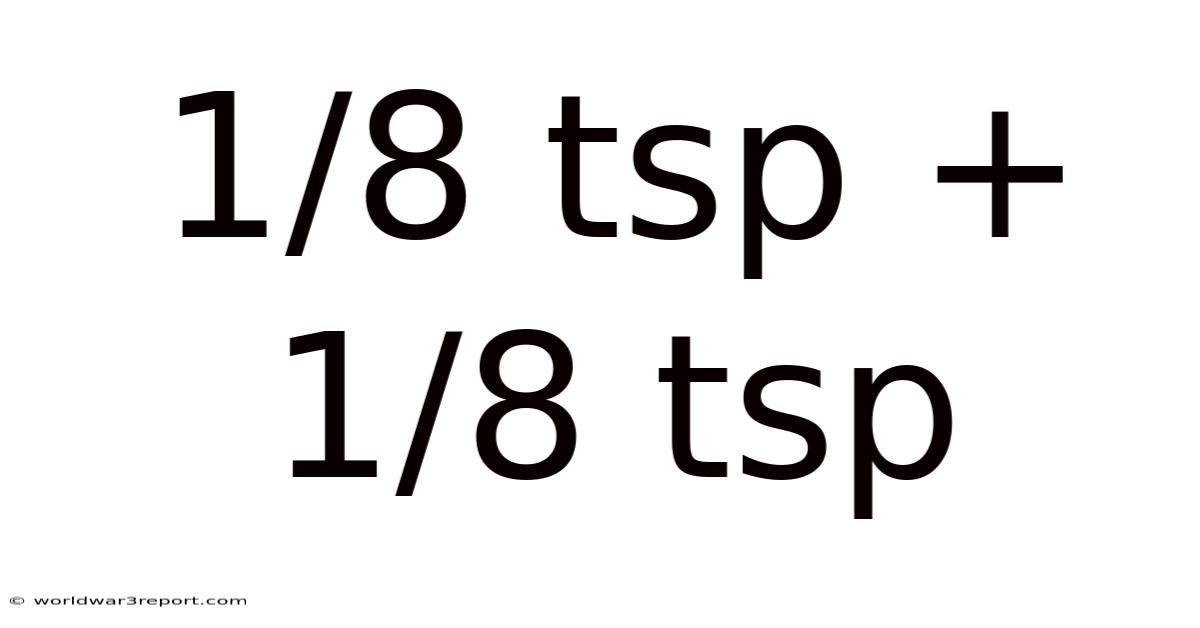
Decoding the Mystery: Understanding 1/8 tsp + 1/8 tsp
This article looks at the seemingly simple equation of 1/8 teaspoon + 1/8 teaspoon, exploring its mathematical implications, practical applications in cooking and baking, and the importance of precision in measurement. We'll go beyond the basic addition to explore the broader concepts of fractions, measurement accuracy, and its relevance in various fields. This seemingly simple addition problem opens doors to a deeper understanding of fundamental mathematical concepts and their real-world applications.
Introduction: The Significance of Small Measurements
The seemingly insignificant addition of 1/8 teaspoon + 1/8 teaspoon might seem trivial at first glance. Precise measurement is crucial for achieving consistent and predictable results. Still, understanding this simple calculation holds significant importance in various fields, especially in cooking, baking, chemistry, and pharmacology. Also, in cooking and baking, even minor discrepancies in ingredient quantities can drastically alter the final product's taste, texture, and overall quality. This article explores the mathematical principles behind this addition and its practical consequences.
Mathematical Explanation: Adding Fractions
Mathematically, adding 1/8 + 1/8 is a straightforward addition of fractions. Since the denominators (the bottom numbers) are the same, we simply add the numerators (the top numbers) and keep the denominator unchanged:
1/8 + 1/8 = (1 + 1) / 8 = 2/8
This fraction can be simplified by dividing both the numerator and the denominator by their greatest common divisor, which is 2:
2/8 = 1/4
That's why, 1/8 tsp + 1/8 tsp equals 1/4 teaspoon. Consider this: this simple calculation forms the foundation for more complex fractional arithmetic and is a cornerstone of mathematical understanding. Understanding this basic principle empowers us to tackle more layered fractional problems, laying a solid foundation for more advanced mathematical concepts Worth keeping that in mind. No workaround needed..
Practical Applications in Cooking and Baking: Precision in Recipe Following
The precision required in cooking and baking often hinges on the accurate measurement of ingredients. A recipe might call for 1/8 teaspoon of baking powder or a specific spice. Adding two 1/8 teaspoon amounts means the cook or baker is actually using 1/4 teaspoon of that ingredient. This seemingly small difference can significantly impact the final outcome.
For example:
- Baking: In baking, leavening agents like baking powder and baking soda are crucial for creating a light and airy texture. Even a slight deviation from the specified amount can result in a dense or flat baked good. Using the correct amount, calculated precisely as 1/4 teaspoon when combining two 1/8 teaspoons, is critical for success.
- Flavoring: The subtle addition of spices or extracts can greatly enhance the overall flavor profile of a dish. Precise measurement ensures the desired intensity of flavor is achieved. Adding two 1/8 teaspoons of vanilla extract instead of the specified 1/4 teaspoon might result in either under- or over-flavoring the final product.
- Consistency: Using accurate measurements ensures consistent results every time a recipe is prepared. This is particularly crucial for bakers who want to achieve consistent rise, texture, and taste in their products.
Beyond the Kitchen: Applications in Other Fields
The principle of accurately adding small measurements is not limited to cooking and baking. It has widespread applications in other fields:
- Pharmacology: In pharmacology, precise measurements are crucial for administering the correct dosage of medication. Incorrect dosages, even by a small amount, can have serious health consequences. The understanding of fractional addition is vital for accurate medication preparation and administration.
- Chemistry: In chemical experiments, precise measurements of reagents are crucial for achieving the desired reaction and obtaining accurate results. Small deviations in measurements can significantly alter the outcome of a chemical reaction.
- Engineering: In engineering, precise measurements are used to ensure the accuracy and precision of various components. Small discrepancies in measurements can compromise the structural integrity or functionality of a system. This requires a thorough understanding of fractions and precise measuring techniques.
Measurement Tools and Techniques: Ensuring Accuracy
Achieving accurate measurements requires the use of appropriate tools and techniques. For measuring small quantities like 1/8 of a teaspoon, several tools are helpful:
- Measuring Spoons: A set of measuring spoons, including an 1/8 teaspoon measure, is essential for accurate measurement. it helps to use spoons specifically designed for measuring ingredients. Using ordinary spoons can lead to significant inaccuracies.
- Measuring Cups: While primarily used for larger quantities, some measuring cups also have markings for smaller measurements, including 1/8 teaspoon.
- Digital Kitchen Scales: For greater precision, especially with denser ingredients, a digital kitchen scale offers the most accurate measurement. It allows for accurate measurement by weight, bypassing potential inaccuracies associated with volume-based measurements.
Tips for Accurate Measurement:
- Level Measurements: Ensure the ingredient is level with the top of the measuring spoon or cup. Avoid overfilling, as this will lead to inaccuracies.
- Use the Right Tool: Select the appropriate measuring tool for the quantity being measured. Using a larger spoon to measure a small amount will result in inaccuracy.
- Clean Spoons: Clean measuring spoons between measuring different ingredients to avoid contamination and ensure accurate measurements.
Frequently Asked Questions (FAQ)
Q1: What if I don't have an 1/8 teaspoon measuring spoon?
A1: If you don't have an 1/8 teaspoon measuring spoon, you can approximate it using other measuring spoons. You can carefully fill a 1/4 teaspoon measure halfway to approximate 1/8 teaspoon. Take this case: 1/8 teaspoon is half of 1/4 teaspoon. Even so, this method lacks the precision of a dedicated 1/8 teaspoon spoon. A digital scale is the most accurate alternative Simple, but easy to overlook..
Q2: Can I use a larger measuring spoon and estimate 1/8 teaspoon?
A2: While possible, estimating 1/8 teaspoon using a larger spoon is significantly less accurate. The margin of error increases, potentially leading to inconsistent results in cooking and baking or inaccurate measurements in other fields.
Q3: Why is precise measurement so important in baking, specifically?
A3: Baking relies on precise chemical reactions between ingredients. The ratio of ingredients is critical to the structure and rise of the baked goods. Minor inaccuracies in measurements can result in a failed recipe, leading to a dense cake, flat cookies, or other undesirable outcomes Which is the point..
Q4: Are there any online resources or tools that can help with fractional calculations?
A4: Many online calculators and converters are available to help with fractional calculations. These tools can simplify the process of adding, subtracting, multiplying, and dividing fractions.
Conclusion: The Power of Precision
The seemingly simple addition of 1/8 tsp + 1/8 tsp highlights the importance of precision and accuracy in various fields. Understanding the mathematical principles behind this calculation, coupled with the proper use of measuring tools and techniques, ensures consistent and reliable results. The ability to accurately measure and perform simple fractional calculations empowers us to achieve consistent results and understand the subtle nuances that impact the outcome of various tasks, from baking a cake to performing a scientific experiment. While this simple problem serves as a foundation, the broader principles of accurate measurement apply across countless disciplines, emphasizing the significance of even the smallest details. This foundation in precision forms a vital skill applicable throughout life Easy to understand, harder to ignore. No workaround needed..
